World Motor Sport Council concludes year of collaboration, growth and development at every level of competition
- Newly-defined Constructors at the heart of WRC27
- Next phase of Global Karting Plan begins
- Grassroots category to bolster rallycross pyramid
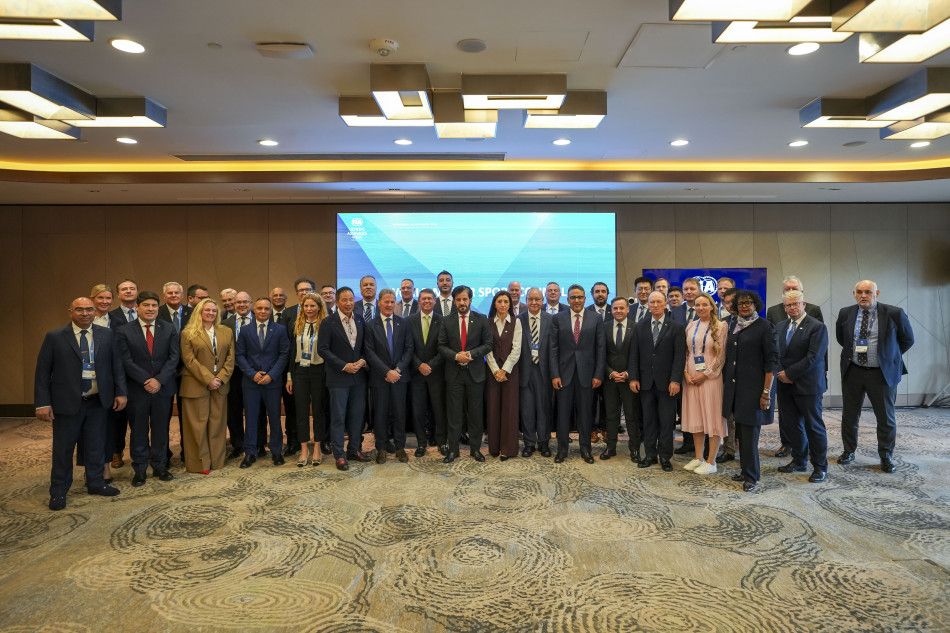
The final meeting of the FIA World Motor Sport Council in 2025 has been held today, 10 December, during the FIA General Assemblies Week in Tashkent, Uzbekistan. The meeting was attended by delegates from the international network of National Sporting Authorities (ASNs) that together make up this global federation.
Central to the discussions and decisions taken was the base of the motor sport pyramid – the development of grassroots initiatives and categories without which the entire motor sport ecosystem would cease to function.
The FIA President, Mohammed Ben Sulayem, began the meeting by highlighting the strength and dynamism of the FIA’s global portfolio of sporting competitions.
“2025 has been a year of collaboration,” said the President. “It has been a year of growth, and a year of development. Together we have strengthened our championships, and we go into the 2026 seasons with calendars that represent our global community.”
President Ben Sulayem reflected on this final World Council meeting of his first term in office, adding:
“These have been years of momentum, purpose and delivery. New, historic agreements across our championships have unlocked fresh opportunities and strengthened the very foundations of our sport. We are engaging a wider global community – welcoming new drivers, new talent, new fans, new volunteers, and new colleagues.
“Together, we remain focused on our mission: to deliver motor sport that is safe, inspiring, and sustainable. That continues to deliver for our future generations.”
The following is a summary of decisions taken at today’s meeting:
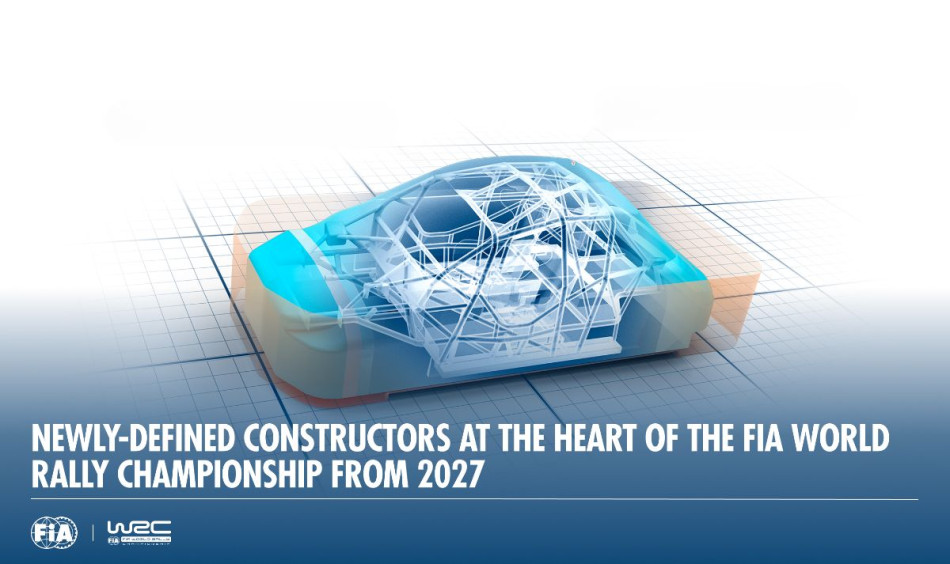
The final elements of the regulatory framework for the FIA World Rally Championship (WRC) from 2027 have been approved today by the World Council. The final homologation regulations that complete this framework set out key definitions and requirements as the WRC enters a brand-new era with growth and increased competition at its heart.
The WRC27 technical regulations, originally approved in December 2024, have since undergone a final phase of refinement over the past year, and today’s confirmation of the homologation regulations concludes this process, providing constructors with a clear, long-term structure for the development and production of the next generation of rally machinery.
The homologation regulations define and clarify the full homologation procedure for WRC27-type cars and outline the duration and conditions attached to each homologation, as well as minimum production requirements for homologated cars.
This introduces a formal definition for Constructors – bringing the Manufacturer and Tuner entrants under a singular umbrella as entrants in FIA World Rally Championship. A Constructor is the entity responsible for designing and building the WRC27-type car, preparing and submitting the vehicle for FIA homologation, and commercialising the car and its associated components.
The homologation conditions for WRC27-type cars mandate the production of at least ten units within twenty-four months of the homologation date. Constructors must also be capable of supplying at least ten race-ready WRC27-type cars per calendar year to customers. Where a Constructor supplies a second Constructor for partial homologation, the minimum production of the base car or car variant may be reduced relative to the supply to the second Constructor. In addition, the regulations confirm that the homologation of a WRC27-type car is valid for a ten-year period.
In line with the FIA’s target to increase the number of competitors in the top category of the WRC, the requirements for entry and participation have been updated, The regulations stipulate that homologation may only be granted once a constructor has officially registered for the championship, and participation requirements have been introduced so that a homologated car must contest at least fifty per cent of WRC events in its first year with a minimum of two cars per rally, increasing to full participation across all events from the second year.
With the homologation regulations now confirmed, the foundations are in place for the championship’s new era in 2027, providing stability, clarity and long-term direction for Constructors, Teams and Competitors, setting the stage for a spectacular rally competition brought to fans all around the world.
FIA Global Karting Plan set to build on 2025’s success
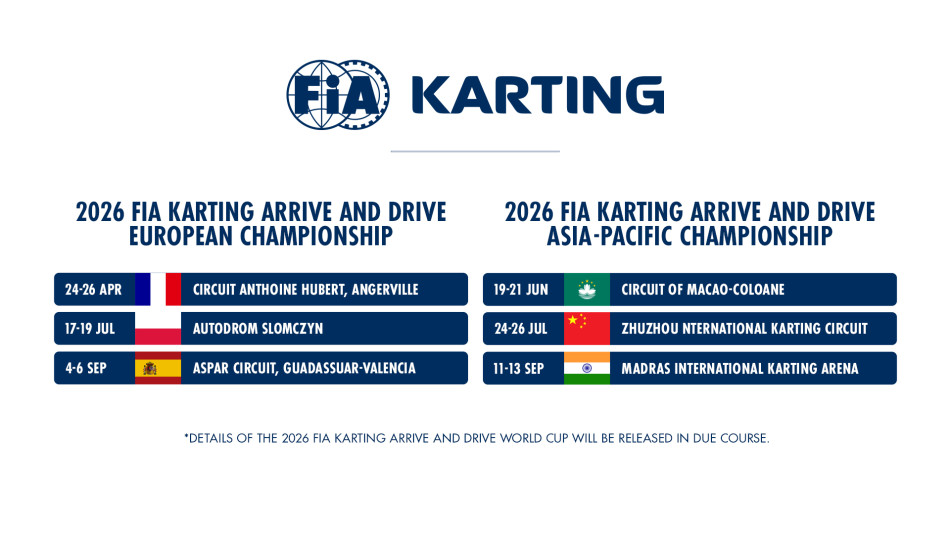
The World Council today approved regulations to support an expansion to FIA Karting as it begins the next phase of the Global Karting Plan rollout which will next year include new Arrive & Drive championships as part of one of the most extensive calendars to date.
Following the successful inaugural FIA Karting Arrive & Drive World Cup in Malaysia last month, the innovative format will expand with new Continental Championships to bring the affordable and accessible events closer to communities around the world. The 2026 calendar, which has been approved today, will feature a Europe and an Asia-Pacific Championship, each comprising three rounds with the winners earning a grid spot in the end-of-season 2026 FIA Karting Arrive & Drive World Cup.
An updated sporting format will also raise the tension and excitement of Arrive & Drive qualifying whilst increasing the track time for every driver. By replacing timed qualifying practice with 6- or 8-minute sprint races to determine the qualifying heat grids, each weekend will feature more racing action and provide more opportunity for the drivers to prove themselves on a global stage.
14 drivers will form each sprint heat with the first grid assigned randomly and reversed for the second heat. The classification of these sprint heats will then set the grid positions for the following qualifying heats before the grids are set for the finals.
The Impact Data Recorder, successfully introduced earlier this year in the FIA Karting Academy Trophy to provide valuable data and analytics following track incidents and an important tool to inform the safety innovations of the future, will be mandatory in all FIA Karting Championships from 2026 and in all other international Karting events from 2027. ASN’s are also encouraged to implement the rollout of the device at a national level which has already generated invaluable data to inform the safety advancements of both karts and circuits.
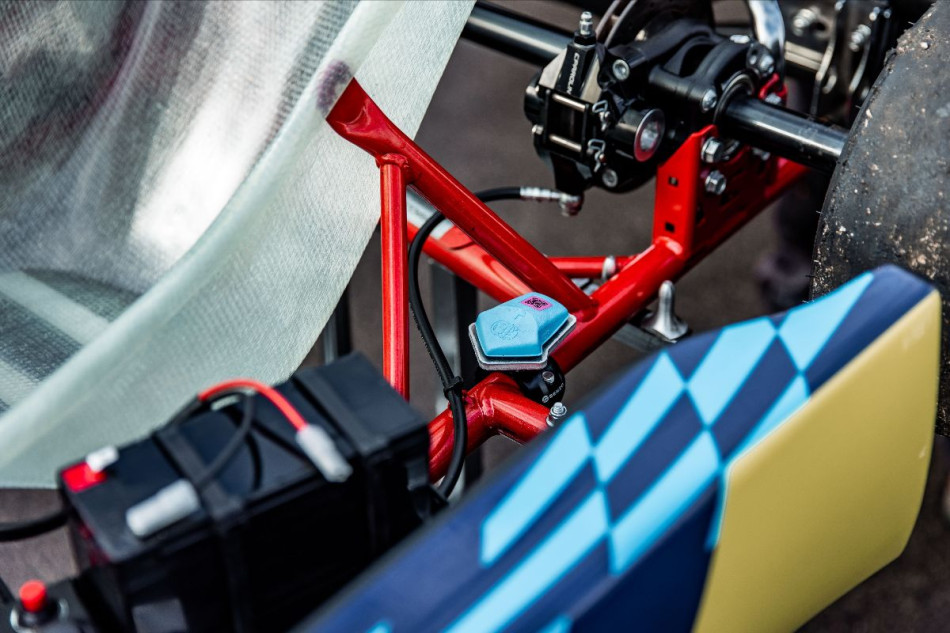
Finally, the FIA Karting Senior Academy Trophy will also expand next season following a successful inaugural season with the number of drivers increasing from 36 to 54 and the age limit raised from 16 to 17. This expansion will open new opportunities for drivers to represent their country whilst supporting their progression in the sport.
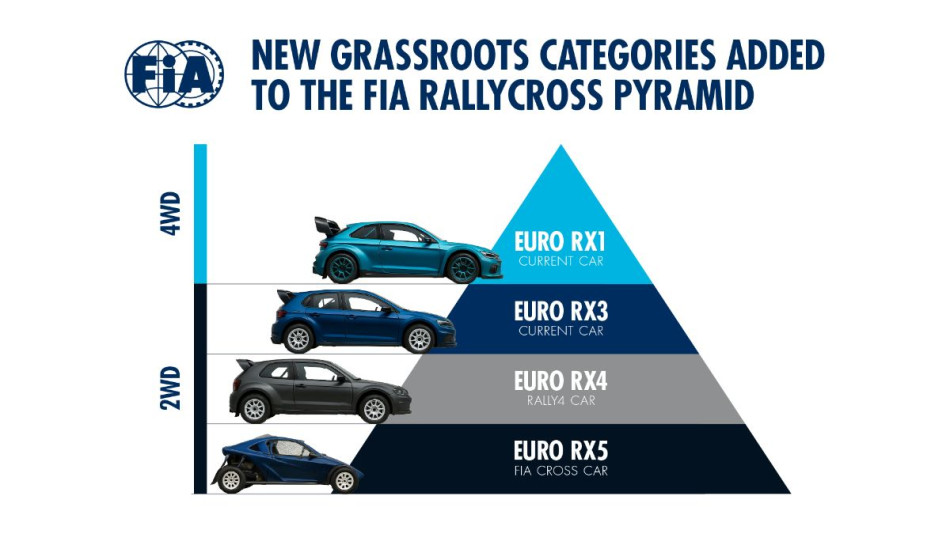
The World Council has approved the introduction of two new grassroots categories, RX4 and RX5, which will join the FIA European Rallycross Championship from 2026. Their inclusion reduces barriers to entry, increases technical diversity and strengthens the development pathway for emerging rallycross talent.
The newly created RX4 category will utilise existing Rally4 machinery with minimal adaptations, primarily the removal of the co-driver’s seat and associated equipment. By drawing on a well-established platform used across national and international rallying, the category will provide a cost-effective entry point for competitors progressing from national rallycross series, seeking their first step into international Rallycross competition.
The introduction of Rally4 machinery into international rallycross competition also represents the first tangible step towards the FIA’s 2028 vision for the discipline, in which cars used in the top tier of the FIA World Rally Championship will become eligible for the premier category of rallycross.
RX5 will introduce Cross Car vehicles into the FIA European Rallycross Championship for the first time. Using the technical specification from the FIA European Cross Car Championship, the category offers an accessible grassroots route for younger competitors beginning their international careers, while supporting the continued growth of the discipline across Europe.
Both categories are designed to broaden participation, create opportunities for drivers who already own eligible vehicles and reinforce the championship’s commitment to developing the next generation of rallycross talent.
The World Council today also approved an updated format for General Rallycross Sporting Regulations designed to provide a unified but flexible regulatory framework. This will make it easier for ASNs and organisers to harmonise national and international rallycross events.
Regulatory updates:
FIA Formula One World Championship
The FIA President Mohammed Ben Sulayem and World Council Members recognised the fantastic spectacle of the recently-concluded 2025 championship battle, in which three drivers remained in contention until the final race for the first time since 2010.
“For the first time in 15 years, there was a three-way fight for the championship decided at the final race – and what a race it was,” said President Ben Sulayem. “This year-long battle was a fitting end to the current regulations cycle, as we look forward to the significant changes that will come in 2026.
“The new technical regulations we have discussed and approved within this Council will deliver safe, sustainable, and thrilling racing. Thank you to all involved with this process that will drive Formula 1 into a new era.”
With the new approved Regulations, the new structure of the 2026 Formula 1 Regulations has finally been completed. The Regulations are now split in six sections as follows:
- Section A: General Regulatory Provisions
- Section B: Sporting Regulations
- Section C: Technical Regulations
- Section D: Financial Regulations (for F1 Teams)
- Section E: Financial Regulations (for PU Manufacturers)
- Section F: Operational Regulations
The World Council approved the creation of the new ‘Section A’ of the Formula 1 Regulations. This ‘General’ section creates consistency between all other sections and to avoid duplications or contradictions. It adopts a more rigorous legal framework, previously introduced with the Financial Regulations.
Minor updates and refinements to the other Sections of the F1 Regulations were approved by the World Council.
The main sporting changes are:
- Sprint Qualifying dry tyre limitations will no longer be removed when a period of Sprint Qualifying is declared wet.
- The operational personnel limit for 2026 will temporarily increase to 60, to ensure teams can operate the new generation of cars effectively.
- Race suspension and resumption procedures have been simplified.
- The return to single pre-season test from 2027 onwards has been confirmed.
- Out-of-Competition Tyre Testing car specifications have been amended as necessitated by the generational car change for 2026.
- An allowance has been made for FP1 at a Sprint event to be extended following a red flag, to ensure that competitors are afforded relevant practice time.
- There have been updates to Driver Adjustable Bodywork (SLM / CM) usage – these amendments have been made to ensure congruity with Technical Regulations, as well as finalise details of SLM usage in several scenarios.
The main technical changes are:
- Minor changes to Article C3 for clarification, including those related to deflection tests procedures.
- Changes to the power unit regulations were made to refine the energy management provisions
FIA World Rally-Raid Championship
The removal of the prologue and power selective section in W2RC events, approved earlier by e-vote of the World Council, streamlines the one-week W2RC rally-raid format for greater efficiency.
Under the new format, Day 1 will be reserved for private tests and checks for non-registered competitors. W2RC crews will then complete their checks on Day 2, followed by shakedown and promotional activities.
The revised structure also addresses the impact of the championship leader opening the road on Stage 1, by limiting its milage to no more than 15% of the total competitive distance. Stage 5 remains capped below 10% to ensure podium activities can take place on the final afternoon.
Spare-Parts Limits for New Stock Vehicles:
The World Council approved a proposal to place limits on the number of spare-parts for the new production-based Stock vehicles in the FIA World Rally-Raid Championship. A dedicated appendix will set out the maximum number of permitted components and sub-assemblies, with time penalties applied if competitors exceed those limits. The new measure supports cost control and aligns the category with its customer-racing purpose.
GT Commission
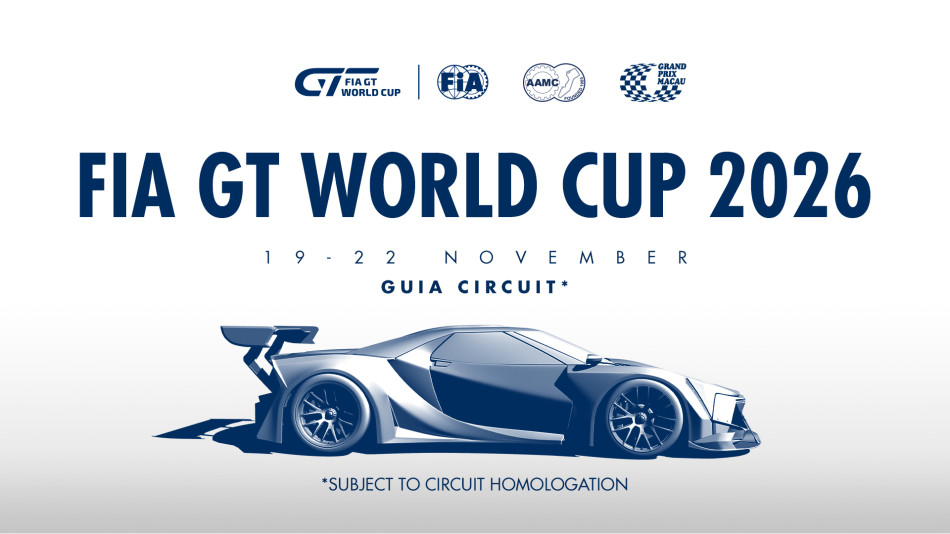
The date of the ninth edition of the FIA GT World Cup, traditionally taking place at Guia Circuit as part of the Macau Grand Prix, has been approved.
Touring Car Commission
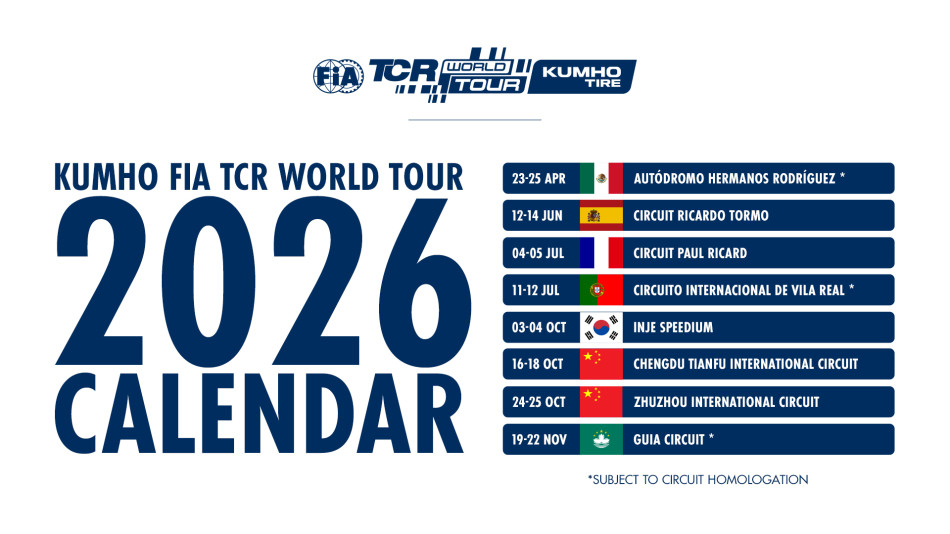
The calendar of the 2026 Kumho FIA TCR World Tour season has been approved as follows:
Drag Racing Commission
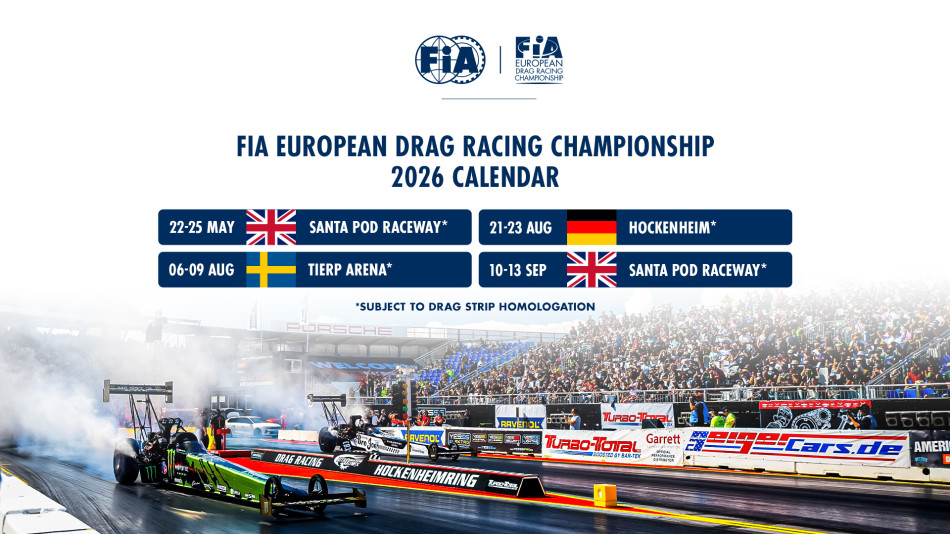
The calendar of the 2026 FIA European Drag Racing Championship season has been approved as follows:
Road Sport Committee
The World Motor Sport Council has approved the introduction of Quarter Finals to the FIA Rallycross competition format from 2026.
Driven by the anticipated increase in entries for the 2026 season, the revised format expands the number of drivers progressing beyond the qualifying phase from 12 to 24.
Safety Committee
The World Council approved a proposal to simplify the cardiovascular aptitude examination section of Appendix L in accordance with the most recent Medical evidence, allowing for simple oversight at age 59 or younger but giving proper evaluation of risk where that risk is expected to be higher, above 60 years old.
A mitigation measure has been added to require rally crews to reduce their speed after the Flying Finish to a stage and make sure they reach the Stop Point at an acceptable speed. In order to make sure that competitors are informed about the mitigation measure deployed, it is required for each Championship to standardise the measure and describe it in the Supplementary Regulations of each event.
Super Licences
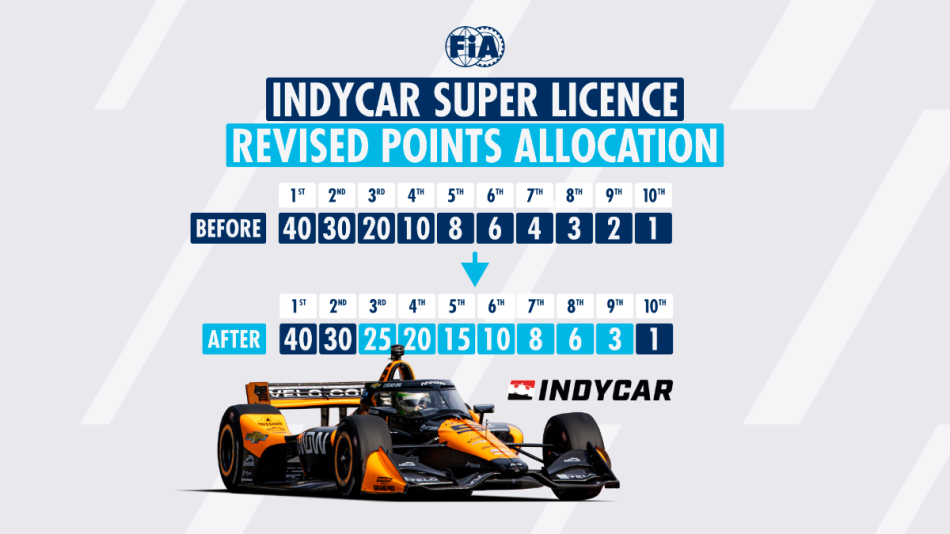
The number of points allocated to the IndyCar Series has been increased for positions from 3rd – 9th to reflect the growing significance of the category as follows:
Cross-Country Rally Commission
Windscreen Protection Devices:
A new regulation to formally permit the use of bolt-on deflector bars or cables to protect windscreens from vegetation has been approved by the World Council. These external devices may be fitted between the front fender and the A-pillar and must be constructed from steel or aluminium.
Powertrain monitoring for T1+ vehicles
The World Council has approved a proposal specifying that the FIA torque meter system applies only to T1+ vehicles entered in the relevant Championship, ensuring monitoring resources align with registered competitors.
Updates to FIA Technical Passports
The World Council has also approved revisions to the FIA Technical Passport procedure at Cross-Country events that further simplifies processing and reduces administrative workload on event organisers and ASNs.
Under the revised guidance, ASNs are now permitted to pre-fill technical passports for batches of identical vehicles, beginning from the fourth unit produced, subject to agreement from the FIA Technical Department. This would remove the requirement for repeated pre-inspections of identical vehicles and streamline the application process through a single FIA contact point.
 Facebook
 Twitter