F1 - 2026 Japanese Grand Prix - Thursday Press Conference Transcript
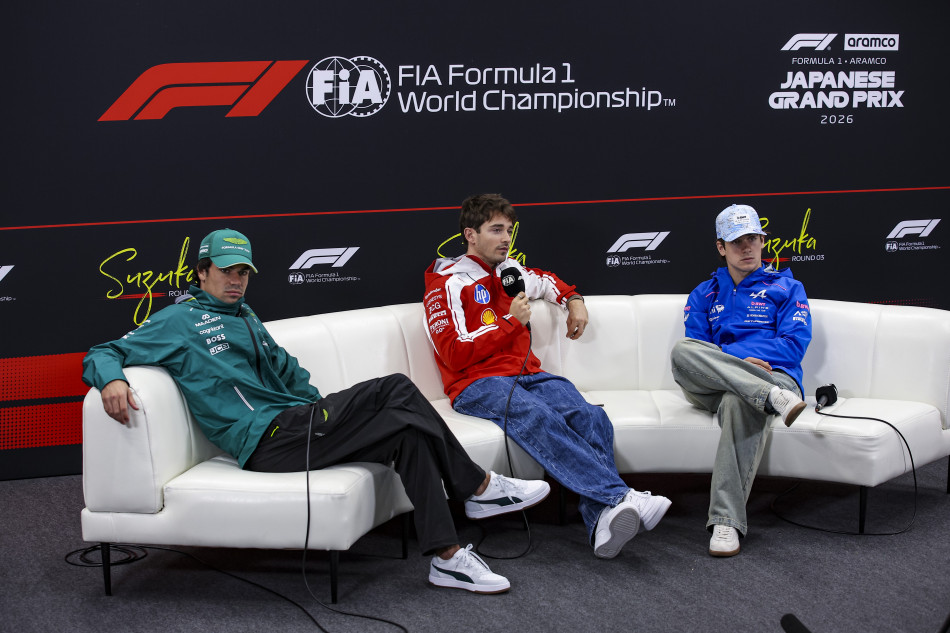
PART ONE – Lance STROLL (Aston Martin), Charles LECLERC (Ferrari), Franco COLAPINTO (Alpine)
Q: Franco, if we could start with you, please. A brilliant race last time out. Just how much of a breakthrough was China for you?
Franco COLAPINTO: It was good. I’ve been looking for those points for a long time and it was really positive for me and for the team to have a double points finish, again, after a very long time also, so it’s good. Of course, we were looking for more and it was looking really positive at the start of the race. We were running fifth and sixth. It looked like we could score a whole lot more points and of course the Safety Car kind of damaged our race, mine and Pierre’s as well. Mine, because of the strategy, was much worse. But it was still positive to see the performance, to see that we could fight at the front and that we could be out there with the big teams. I think generally, it was a really positive weekend in China. Coming from Melbourne, it was a big step forward and that was of course really positive and motivated a lot of people in the factory. You could see [at Enstone] I went a couple of days ago everyone was looking really positive, happy and motivated, wanting more, and that’s what we want to see. So yes, good weekend.
Q: Confidence is a fickle thing for drivers. Just how much happier are you with this year’s car compared to last year?
FC: I’m happier, of course. When you can fight a bit further up it makes you feel more confident, makes you give that extra little bit in different situations. I think when you are so close to Q3, when you’re in the fight, it is different. Last year unfortunately we didn’t have that. This year it’s looking much better and of course the car did steps and it’s looking much closer to the other teams. I think also knowing that we have a lot of performance coming, or that we see many different things to improve, it’s also really positive. When you are up there and you know that you’ve got many things to fix and to improve, it’s even better. So, I think looking forward to this year, it’s feeling more competitive and that makes you happier, and of course, we want to be fighting for points consistently, which is what we are looking for and trying to aim at.
Q: And you think you can achieve that this weekend at Suzuka?
FC: Yeah, we’ll see. I think it’s another new weekend, new track, very different on energy, on kind of corners, very long, very high speed, so it’s going to be really different. I think still we need to understand our biggest weaknesses and where we are still needing to work more. China was a really different track to this one, so we need to see. But I think generally it’s new for everyone. No one really knows where it’s going to be and we need to wait until tomorrow.
Q: Lance, if we could come to you now. Difficult start to the year for the team given the problems. How would you describe the mood in the team? Let’s start with that.
Lance STROLL: Well, everyone’s just working as hard as they can to improve the situation for sure. None of us are happy with where we are. It’s not the start to the season that we hoped for, but it is what it is and we’re just working as hard as possible to improve it.
Q: Can we talk about potential improvements? Laps have been limited, we know that, but do you believe the car still has potential?
LS: I think so, yes. We know we have issues on the engine side. There are areas we need to work on with the car. I think high-speed corners are still a weakness for us. So yeah, we’re just trying to improve in all areas that need work and it’s just about bringing performance as quick as we can.
Q: Honda’s home race here in Japan. What does success look like for you here at Suzuka?
LS: We’re just trying to improve the issues we had in China. In China we had big vibration problems, reliability issues, so just tackling some of those problems. I think getting both cars to the chequered flag would already be a good step forward for us.
Q: Final one from me. There’s a lot of speculation surrounding the role of team principal at Aston Martin. What are your thoughts on it? Do you think Adrian has too much on his plate as things stand?
LS: I don’t know all the details about that, but I know Adrian’s team principal right now. I know that we have to improve the engine, we have to improve the car, and I think that’s what everyone’s focused on.
Q: Alright, thank you for that. Charles, if we could come to you now. Two races, two podiums for Ferrari so far this year. How much potential does this year’s car have?
Charles LECLERC: Well, I think, as everyone is saying, this championship is going to be all about development and the upgrades that each team is going to bring. For now, we are in an okay-ish place, but of course we’re not here to only do podiums and we want to win races, which at the moment seems very difficult because Mercedes is at a very high level. But we are working very hard and especially the people back at the factory are working extremely hard to bring upgrades as soon as possible. I know there are quite a few things coming up soon. Whether this is going to make the difference or not, I don’t know, and I’m pretty sure the others are not on vacation either, so it’s going to be tough.
Q: You say you’re in an okay-ish place. Just how close to Mercedes are you?
CL: I don’t think it’s as close as maybe people think. Obviously the first few races we see lots of fighting between the cars, which is actually quite nice, but as soon as you are a little bit suboptimal with these cars you lose a lot of lap time. So, our only chance to stay with them is to annoy them in the first few laps, but as soon as they get free air then they’ve shown their real pace in the last race, and I think there’s still these four or five tenths that we’ve seen throughout these first two races. So. it’s still a significant advantage. But yes, that doesn’t discourage me and again we have some things in the pipeline. We’ve got to focus on ourselves, not trying to overdo it because it’s never good in these situations, and then we’ll see where that brings us.
Q: The gap between you and Mercedes appears to be a little bigger in qualifying than it is in the race. Do you think the energy recharge changes for qualifying here at Suzuka will bring you closer to them?
CL: I don’t think it will be a game changer. I think it will be pretty similar, apart from for the driver where maybe there’s a little bit less lift and coast, which is I think a good thing. I think for qualifying there are still some changes that need to be done to make sure that we can push at the maximum, whatever the limit of the car is. But at the moment, so far for the first two races, it was more about managing everything properly in qualifying rather than the actual flat-out push that we were used to in Q3 in the past years. So, there’s still some fine-tuning to be done on that, but I don’t think that this particular change will be a game changer for this weekend.
QUESTIONS FROM THE FLOOR
Q: (David Croft – Sky Sports F1) Charles, on that subject then, of tweaks that can be made for qualifying, what would you do if you had the power to improve things? What would your suggestions be?
CL: I don’t really want to go into the detail of this because it’s so complex and there are so many different little things that you can do. I also think that obviously whenever there are these kinds of changes everybody is pushing a little bit his agenda. But I think, just whatever solution helps us to push at the maximum those cars, because that’s what I loved, that’s what I love about this sport is when you get to Q3 and you have the maximum pressure on you to deliver at your best at that moment and that you try and do a lap that you haven’t done before. At the moment this is not possible because every time you do something that you haven’t done before then the car is just trying to adapt to it and it makes you lose more than what you gain. I think this is the biggest problem at the moment. The solutions are very, very, very complex, but I know that everybody is trying to brainstorm ideas in order to find the best solution and hopefully we come with a good solution very soon.
Q: Charles, have you done a qualifying lap of Monaco on the simulator with these cars yet?
CL: We’ve got quite a lot of issues to solve, so Monaco is quite a long way before we think about it and try it. So no, I haven’t tried Monaco yet.
Q: (Mara Sangiorgio – Sky Sports F1, Italy) A question to Charles. On this track, Ferrari can do something like Max did last year, beating the stronger McLaren?
CL: I think it’s a very different situation. I think after the first free practice we’ll already have an idea of where we stand compared to Mercedes. I don’t see any characteristics that would change drastically what we’ve seen in the first two races, so at the moment I will say no. But yes, let’s wait and see. There are still some very long back straights where we know Mercedes is going to be extremely strong, but it’s also a very twisty track in the first two sectors, so hopefully we can have a big enough advantage to be faster on the overall lap. But at the moment it looks unlikely with the picture that we’ve made ourselves in the first two races.
Q: (Raphael Sampt – Servus TV) Question for Charles. Sebastian Vettel once said, “In some way everybody is a Ferrari fan,” and people love to see you fighting up front again. After all these years in red, what is Ferrari to you?
CL: Ferrari is family and a team that I’ve always loved and dreamed of driving for since I was a kid, and this hasn’t changed one bit since I joined the team in 2019. So, the passion is still there. Then of course the will to win, and we want to win eventually, and I want to win. It’s been so many years obviously working with the team to try and come back to the top. It’s been a good step forward this year, we are just not yet where we want to be, and we’ll keep pushing towards that direction. I hope our time will come soon because yes, it’s been a long time since I started and obviously time has passed. I’m doing my best and I hope our time will come this year or as soon as possible.
Q: (Andrew Benson – BBC Sport) Charles, there have been two different races on different tracks where there’s both been these yo-yo type racing battles that you’ve been involved in, among others, perhaps for different reasons. Can you explain why those battles are happening in that way, and if it’s different from track to track, the reasons why? And also on a wider scale, is it like Mario Kart, as some people have said?
CL: Honestly, I was very sceptical at the beginning of the year, and after testing I had some particular expectations going into the year that weren’t very good about racing. I’ve been positively surprised. At least for us in the front, it’s actually been a lot nicer than what I thought. Surely, you’ve got some overtakes that are artificial, just like it was the case also with the DRS sometimes last year. However, there are also many overtakes where it’s actually on the limit and where you end up in a similar state of the battery at the same point for different circumstances, which makes it actually quite fun. We’ve seen it in Australia, we’ve seen it in Shanghai, and I’ve had a lot more fun than I initially thought. As I said, I think in qualifying it’s not the most fun I’ve had, so this is maybe something that we need to look at. But in terms of fighting, I enjoyed it a lot more than what I thought. And why that’s so, it’s mostly because Mercedes is quite a bit stronger than us, but as soon as you get out of that optimal window of the battery, you lose a lot of lap time. So that brings the cars together and that’s why there’s a lot of change of position, together with the fact that the car behind recharges more than the car in front. These two things specifically make it quite difficult to go away once you are in a fight.
Q: Franco, can I bring you in on this? You were involved in many battles in China. Was it like Mario Kart for you? How much did you enjoy it?
Franco COLAPINTO: Not quite. I managed to stay in front for a lot of laps, so to me it was quite fun. I think for me it felt better and more fun to be fighting with cars with a different PU because I think that energy management is different between the teams and between the different PU manufacturers, and then it becomes a bit easier, I think, to fight, to defend as well, maybe a bit more difficult, but it kind of brings battles a bit closer with each other because it is so different where the teams use energies, which makes it a bit more interesting. I think generally it is difficult to follow, but I’ve been following some cars closely and it feels better than last year in terms of turbulence and all that kind of thing. To be honest, it felt fun. China was a good race and I did enjoy it quite a lot. I enjoyed the defence and when I was attacking others, and generally it was pretty good. It didn’t feel too artificial. I think the overtakes were just on the limit all the time. I’ve seen some that were a bit more artificial, but I think it’s part of the changes that the sport made and that’s still improving and it’s still going in the right direction. I think there are still a lot of areas to make better, and the important part is that they are looking at those and that they understand them and that they are having, I think, a clear look at it, and they will make it better with the races. It’s been only two races at the minute. It’s really early to say if we like it or not, but I think generally it’s going to be better with the races as well and with the years.
Q: (Ronald Vording – Motorsport.com) It’s another one for Franco. There are some talks lately about the potential show run from you in Buenos Aires. I don’t know if you’re in a position to confirm that, but even if not, what would it mean in general terms? And also. what would it mean to you to drive an F1 car in Argentina with all the enthusiasm going on?
FC: It would be super cool. It’s something I always wanted to do because it’s so hard for the people from Argentina. I’ve got so many fans and so many people supporting me since I was very little, in F3, and it’s been 25 years since an Argentine driver raced in F1. So, I think for me to be able to bring a Formula 1 car to Argentina with all these super passionate people and fans of the sport, it would be super cool. I know it’s really hard for them to come to races. It’s such a big effort and such a big sacrifice, that for me, the team and sponsors to be able to bring a car there for them to enjoy and to experience it would be amazing. I don’t think anything is confirmed or close to it, but it’s a dream I had since I joined F1 and something that in the future would be amazing to happen. I don’t know if now or whenever. I would really like that this thing goes ahead. Let’s see. But yeah, I have no news or nothing confirmed. It’s just a dream in my mind.
Q: (David Schneider – Shiga Soprts, Japan) Question for Lance. Obviously the vibration is the main focus right now for improving the car, as well as the reliability. Once that is resolved, how quickly do you expect the pace of your car to catch up with the midfield?
LS: Well yeah, we need to improve the vibration, we need to improve the reliability, but even when we’re finishing laps we’re three seconds off, three and a half seconds off the lead cars, so there are a lot of things to improve. Even when we fix the vibration and improve the reliability, we need to find performance, like I said earlier, in the engine, more power and more downforce. So a lot of areas to work on.
Q: (Jon Noble – The Race) To Charles on the qualifying issue, your Sprint qualifying second effort in China is a good case study of quirks of one part of the track affecting deployment elsewhere. How hard was it and what was your reaction when you found out that a throttle lift in one corner kind of wrecked energy deployment half a lap later? And is the key for qualifying to maybe put more of this energy deployment in the hands of the drivers rather than computer code?
CL: I think there are some fine-tunings like the one you just said, with that very small lift, which was I think out of Turn 9, which kind of changes all the deployment and then I lost half a second on one straight. These are the kinds of changes that I think we’re all little by little pinpointing to the FIA, and I’m sure that there will be some changes in the future to try and address those issues because it’s a little bit silly to lose half a second just because of a very small lift at some point. What was my reaction? I was very frustrated, very, very, very frustrated, because these things that you… I mean the lift was, I think, two percent or three percent of throttle, which is kind of nothing. It’s in the vibration of the foot. So yes, it’s not something that I expected at all, but it’s something that I had experienced also before since testing, so I knew it was a possibility, and these kinds of things can happen. But when it happens it’s very frustrating, especially when it’s in Q3.
Q: (Ben Waterworth – Speedcafe) Question for Lance. You were touching on the vibrations before. Is there anything that you and Fernando have been able to do physically to try and prepare yourself a little bit more while you’ve got those issues? And for yourself, is there any concern about flaring up your old hand injury with the vibrations at the moment, based on the previous injury you had with it?
LS: Not much to do physically, no. Hand’s all good.
Q: (Scott Mitchell-Malm – The Race) A question for Franco. Franco, the qualifying deficit to Pierre in China, how much of that was down to any differences in car specification, on upgrades on your side? And do you expect to have a completely equal car this weekend?
FC: Yes, I think so. In China we found something, especially Friday evening after that Sprint quali, because it was a very big gap. We knew we had some differences because on Thursday before running my gearbox broke, so we had to swap and that came with differences on the rear suspension, which was an old part that we had in testing. That was the biggest one, and then some front wing under-delivering that we still need to understand more. But I think generally the cars were in a much better place in the race. The rear stayed like that, but it’s part of the issue we had in the gearbox. Here we should have the same. Generally, I’ve been feeling better with the car and compared to Pierre, understanding a lot of the differences in driving that he has because of experience and him racing for so many years in F1 has been really, really helpful to improve myself. I’ve been happier and happier with the car since Melbourne, have been improving and getting closer, and it’s definitely going to help, these things on the rear and on the front wing, getting it a bit closer. But yeah, I think it’s part of the process. The teams are still bringing parts and with new cars we are working really hard back in Enstone, here on track, back in the factory, to bring all the bits and pieces we can to have performance. That race of development between teams is getting bigger and bigger, and the ones that bring the parts to the car quicker are going to have a big, big benefit. So yeah, let’s see here. I think it’s a new track for me, but again one I really wanted to drive on, and hopefully the car is quick and we can fight for more points with Pierre.
Q: (Jake Boxall-Legge – Autosport) A question for Charles please. Charles, you spoke about this being a development season. Could you just talk about what kind of areas of attention are on your shopping list? And do you think it’s realistic for Ferrari to beat Mercedes over the course of the season?
CL: We are still very early on in the season, so yes, I do believe it’s possible. Is it a huge challenge? It absolutely is, and I think also because Mercedes is not relaxing and will keep pushing massively as well. The points of focus at this moment of the season, at this moment of these regulations, are many. Obviously, there is the optimisation of the power unit, that is probably the biggest difference between us and Mercedes at the moment. Just with the optimisation you can make a big difference. Then of course there’s not only that, there’s also raw power, that for now we are down compared to them. Then on the chassis, just all the fine tunings that you can think of, that you always pinpoint at the beginning of the season where you try and understand what is the main limitation that is limiting you. We are starting to have quite a clear picture on what are the characteristics of the car that we need to improve in order to get better. But I think chassis-wise it is quite a strong car actually, and that’s probably our strength so far. Power unit is where we are lacking compared to Mercedes at the moment.
Q: (Ronald Vording – Motorsport.com) It’s another one for Charles. To go back to the yo-yo racing that we talked about before. Franco said it might get better later on in the season with more races. Do you think that yo-yo racing will get less the more teams learn about energy management, or is it just part of the DNA of these regulations?
CL: I said the same thing actually after Australia, but in Shanghai we had obviously a Sprint race and then the normal race, and so the sprint race was I think a good way to test those strategies and to make sure that we were in a good window for the race. Actually, in the race we still had quite a lot of overtakes. So, I think we might see a little bit less of it going forward. However, I was surprised that it didn’t get much better from Sprint race to race, in a positive way. I think it was as good for overtaking. So yes, I’m a little bit mixed. After the first race I was pretty sure it was going to get less and less. Yes, there will be less and less yo-yo effect, however after Shanghai probably there’s quite a bit coming from the car as well and that will remain.
Q: (David Croft – Sky Sports F1) So a question for Lance. A lot of people are talking about when Aston are going to get improvements, when is the engine going to… From a driver’s perspective, how painful is it to drive this car? At what stage into a stint or into a race do you start to feel those vibrations hurting you? How much longer do you think that you can carry on? Obviously there wasn’t anything you could do about the retirement there. What are the sensations feeling like from a driver’s perspective right now?
LS: I think we can complete like half the race, but then also we just have reliability issues. So yeah, it’s very uncomfortable. But at the end of the day, we just want to be much more competitive as a team. That’s the most painful thing for everyone. We’re all pushing very hard to just bring more performance and get back in the fight where we want to be, which is up at the front of the pack. So that’s everyone’s focus and it’s just about getting there as quickly as we can.
Q: (Scott Mitchell-Malm – The Race) A question for Charles, but if I have the other two drivers have anything to add, please do. With the trade-off here for energy management in qualifying, I just wondered, I know the end of the longest straights are obviously going to be big priority areas, but for the Degner curves, Turns 8 and 9, those are probably the two best corners on the circuit just in terms of how you attack them. Is there a risk at all that that ends up a bit like Turns 9 and 10 in Melbourne where you’ll have to energy-manage so much on the entry to Degner One that the entry speed is so low that it’s not the challenge that it used to be?
CL: I’m not 100 percent sure yet because I did the simulator, but these new rules weren’t out yet, so I did it on the previous kind of qualifying rules. My feedback was that it was quite a shame for Turn 8/9, for also some of the corners which weren’t really corners where we were pushing anymore, but more about energy management. However it’s going in the right direction, the changes that have been made since then, so I hope it can bring back the character of these corners because that’s what makes Suzuka so special and so enjoyable to drive. We shouldn’t lose that, especially in qualifying when you really push the car to the limit. So yes, again, I really hope we have that once we get into the car tomorrow.
Q: (Andrew Benson – BBC Sport) A follow-up to that one. What is the risk of the Esses not being grip-limited in qualifying this year? Charles mainly, but Franco if you’ve got an opinion on that that would be interesting. Lance, I don’t know whether you do, but you might not know because of your car.
CL: I don’t think it will be all power-limited through that. It would be a very big surprise. But again, with these cars we’re probably not going to have a lot of power through the Esses. Before speaking I would like to see also what are the implications of the change that has been made since I was last on the simulator because as I said it goes in the right direction. Then I think we will at one point hit a limit with those cars, but it comes at the benefit of racing because honestly I don’t think that we’ve seen in the last quite a few years in Formula 1 as many overtakes as we’ve seen in the first few races, as much excitement as well at the head of the pack, so that is a good thing. However, it comes at a bit of a cost where in qualifying we need to find compromises. We are trying to work around that at the moment, but we didn’t quite find the fix. So yes, I expect the first sector a little bit less exciting compared to last year for sure in qualifying.
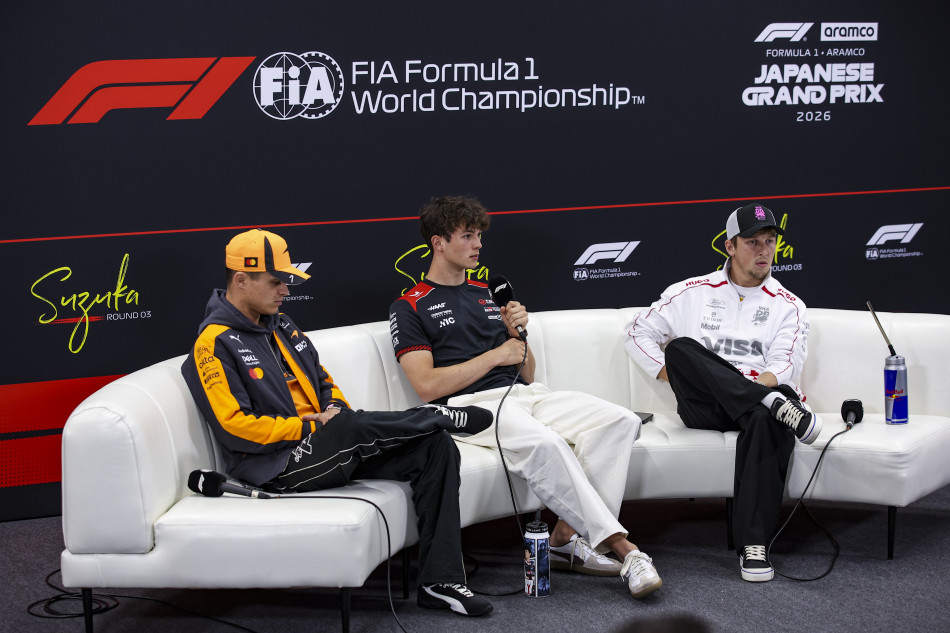
PART TWO – Lando NORRIS (McLaren), Oliver BEARMAN (Haas), Liam LAWSON (Racing Bulls)
Q: Ollie, why don’t we start with you. Look, what a start to the season it’s been for you. You’ve scored at every opportunity and now sit P5 in the World Championship. How do you reflect on the season so far? What’s pleased you most?
Oliver BEARMAN: Yeah, no, it’s been a good start. Obviously it’s round two and I don’t expect to stay P5, it’s a long season, but it’s been a great start. I’m really happy with that. The car has been reliable, so that’s good. I’m happy about that. The car has also been really quick, so yeah, we’ve been able to score some good points. I think now is the time for us to be able to do that, and it’s gone well, so I’m happy.
Q: What aspect of this car are you enjoying the most? Where is it quick? Where do you feel you’re able to get the most out of it?
OB: Well, the chassis and the aero are great. The guys have done a great job, the team bringing us a good car from race one basically. We made a big step throughout the test and the car has improved a lot since the test, and now we’re in a really good place. I’ve been enjoying it. I think on this track it is going to feel interesting, but that’s out of our hands. What we’ve done, the team, I’m really proud of the job they’ve done.
Q: Can we get your thoughts on the changes to the amount of energy recharge that the teams are going to be doing over one lap in qualifying? Do you welcome the change?
OB: I mean it’s just making us even slower. On one hand we don’t have to do any lift and coast any more, which is probably a bit better for us, but it just means we have to do a lot of… I mean we still have to recharge the energy and we spend a lot of time just with no energy because we’re losing one megajoule compared to what we had on the sim and prior to coming here. I think there’s better ways of achieving the same thing. If we could harvest at negative 350 kilowatts while on full throttle, I think it would make everyone’s lives a bit easier. But this is also a solution, I guess.
Q: Thank you for that. Lando, can I bring you in on the subject of the energy recharge in qualifying? Can we get your thoughts? Do you welcome it?
Lando NORRIS: It’s different. I need to go out and drive with it first. I think it will eliminate some things and it will shift around some other bits. I think the thing is you also have tracks where it will be better. Some tracks it will work and be a much better thing, some tracks it won’t change too much. So it should be a little bit better here. It’s not like it’s going to change the whole world. Honestly I need to go and drive on track first and understand it.
Q: Look, before we talk more about this weekend, can we throw it back to China? It was a very tough moment for you and the team, with neither you nor Oscar able to make the start. Do you guys fully understand the cause of the problems?
LN: Yes. Alongside HPP, I think it took a little bit of time to figure things out, but yes. Of course it hurt us as a team, certainly didn’t make us look good to have two cars not starting a race. I think what hurt more is the fact it was out of our control. But with HPP we’ve worked hard to figure things out, to understand how it happened, why it happened, and of course we’ll do everything we can to make sure it doesn’t happen again. But you live and you learn. It was a tough one for all of us. None of us want to have a weekend like that, and especially start a Sunday like that. So yeah, it hurt a lot, but I think at the same time it’s a good time for us to learn and step back and move on to this weekend.
Q: Especially without the mileage in the race in China, you’re still learning about this car. What conclusions are you reaching at this early stage? How much potential does the car have?
LN: The car has a lot of potential. We’re certainly not where we wanted to be, but I think… The real question you probably ask is would I rather be here and have won last year, or would I rather have a slightly better car now and not have won last year, and I think you know what my answer would be. So, you can’t have the best of everything. As a team we certainly are not where we want to be and where we desire to be, but I think we all know within the team what we can achieve. And now is just as good a time as ever to prove exactly what we can do as a team – against Ferrari, against Mercedes, who are performing very well at the minute. But I know all the boys and the girls back in the factory are working very hard and there’s good progress happening. It takes time to improve on some things and it’s not like we’re bad. We’re still third-best team at the minute, but we certainly enjoy being first a lot more than third. So, time will tell. We’ve got some things in the pipeline and like I said everyone’s working hard, so we’re ambitious to get back to the top.
Q: All right, Lando, thanks for that. Liam, let’s come to you now. What a difference a year makes. You’re coming to Suzuka on the back of a brilliant Chinese Grand Prix weekend. Just how much confidence did those two points finishes give you in Shanghai?
Liam LAWSON: Yeah, it was good. It was a good weekend for sure. To be honest we weren’t very, very fast through the weekend, we qualified quite badly and it definitely wasn’t a track that suited us, so we definitely made the best out of it. I think at the start of the race we were aiming to try and get to the points. We definitely didn’t expect to finish where we did. Obviously, it helps having some of the front guys not finishing, but even still we would have been back into the points, which would have been a good race for us. So happy with China. I’m sure this weekend’s going to be tough. Obviously, we have new changes to the cars this weekend that we have to try and adapt to, but it’s been a decent start.
Q: Just from a driving point of view, are you enjoying this year’s smaller, lighter cars?
LL: They’re very different for us to drive at the moment. They’re very different to get used to each track. I think the big difference is we used to go into a weekend spending pretty much all of our time thinking about setting up the car and optimising the car balance. Right now, it’s really energy management. We spend so much time talking about trying to manage the energy and get the most out of that because there’s so much lap time in it. The racing is quite different as well. We have to basically use a lot of different tools and drive a lot differently to try and overtake and defend, and it’s something that we’re still learning. So far, because it’s new, it’s obviously quite different and difficult, to be honest. So, it’s something that we’re also getting used to.
Q: Are you having to be more strategic in your approach to the racing this year compared to last year when you had DRS, for example?
LL: Yeah, I think so. I think there are just more consequences when you get it wrong. If you use too much energy or something like this, it can be quite punishing. So we definitely have to… you’re doing a lot more thinking, I would say, when you’re driving.
QUESTIONS FROM THE FLOOR
Q: (David Croft – Sky Sports F1) It’s a question for Liam and for Ollie, because you’ve had a bit more racing than Lando. Sorry, Lando, I don’t want to talk about China for too much. How have you had to change your driving style this season with the new cars, or have you not had to change your driving style? What’s different in the cockpit when you’re racing this year?
LL: Yeah, I would say it’s quite easy to overdrive. I think in last year’s car you go into qualifying and you try to make quite a big step. Obviously with how much downforce the cars have, you gain grip and you start attacking the car in qualifying. Obviously you can still do it and get it wrong and overdrive, but it was definitely an exciting factor going into qualifying when your car is like… you’re trying to attack it. But I think this year the harder thing is it’s very easy to overstep that and use too much and basically make a mistake. I think this year, pretty much all quali, like Melbourne quali for me, it took me all the way to Q3 on a used tyre to actually just put a lap together, because all the laps before that I just kept trying to attack and basically making a mistake, and actually just bringing it back. So, it’s definitely a different thing that we’re having to get used to.
OB: Yeah, it’s quite a difference, particularly in qualifying. I think there have been some moments where, for example in China, we went through the whole of qualifying and actually on my final lap I did all of my best corners, but I actually went slower by like two tenths because sometimes actually going faster in the corners and picking up throttle earlier, it confuses the car and you end up losing outright lap time, which is really strange. Even sometimes there are some corners, not many, but one or two corners per track where if you go on throttle and then lift and return to throttle, it just messes up everything. It can be three percent of throttle and that can finish your lap basically. It happened to me in China and I lost two tenths down the back straight and I was so confused. Then you look back and they’re like, “Oh yeah, you had five percent less battery to start the straight,” and that’s really the difference that it can make. So, it’s tough because I think what they’ve tried to do to help us is already starting this weekend, but it’s tough because the way that we’ve always driven, you push more and more throughout qualifying and you get to that final run, you try to get everything out of it, and it ends up being slower. Actually you’re better off just driving at 99 percent and doing consistent laps, which is a bit against our nature. It’s something we’re having to adjust to. Then in the race I think it’s a bit more straightforward, but definitely in qualifying it takes a bit of adjustment.
Q: Ollie, what do you think a track like Monaco will be like? Will you be back to 100 percent?
OB: Well actually Monaco, because it’s so short, there are so many braking zones. I haven’t done any sim or anything, I haven’t even looked at any stuff for Monaco, but I expect it to be maybe one of the closer tracks to what we’ve had in the past. It’s more those kinds of short straights where you only want to deploy a tiny amount of energy that if you have a snap or whatever and you lift throttle then you deploy way more than you’re meant to. I think Monaco will be a bit more normal. I’m quite looking forward to Monaco.
Q: (Mara Sangiorgio – Sky Sports F1, Italy) ]A question to Lando. Lando, this season has just started and it’s very unusual. Will you be able as a team to fight again, like last year for example, for a title? How much are you confident?
LN: I don’t know. I can’t remember how many points we were behind in 2024 from Mercedes and Red Bull, Ferrari, but I think we were over 150 points or something behind and we still managed to come back and win the Constructors’. I don’t know how far we are behind now, it’s already quite a bit, but I think we’re not necessarily thinking of that just yet. I think what we are thinking of is getting on the podium first of all, and then just returning to winning races. The points then take care of themselves and we’ll see what we can claw back. But we’re confident in that. I want to say I think we’re confident as a team and we believe in ourselves that we’ve won the last two championships and we won the Drivers’ last year because we could build the best car on the grid, and I’m confident we can get back to doing that this year. It just takes time. You have to be patient. But yes, I have a good belief in the team and I think we can have the best car this year.
Q: (Andrew Benson – BBC Sport) This is for all three of you. What’s leading to the yo-yo racing that’s happening at the moment? What different aspects are leading to it, as I think it might be different from track to track? And interrelated to that, how much are this year’s engines going to ruin Suzuka on a qualifying lap, if you know, if you’ve done the sim already, in terms of which corners are no longer grip-limited because you apply the energy saving there, for example? Lando, can we start with you?
LN: It’s never ruined. I don’t think you can ever ruin this track. Will it be as spectacular? I don’t think so. It will not be. But it’s still an incredible track to drive. There’ll certainly be some places where it just won’t be as spectacular. You’ll start clipping into Spoon. That’s one of the quickest corners, where you turn in you are going incredibly quick. Like last year, I didn’t even brake into Spoon entry.
OB: I had to.
LN: You did? Yeah… You’ll learn, you’ll learn. One day, guys. Yeah, didn’t even brake. It took a risk to get to that point and it feels incredible in Quali when you’re pushing it to the limit like that. Like, Degner 1, not even a full lift, that kind of thing… [to OB] You were probably full lift. Ha! Downshift! We might just be flat through those corners now, because you are clipping. It’s a different world. It will be better now, I think. You’ll see some places not as spectacular as what it’s been in the past. But I think it’s still going to be cool to drive in qualifying. Yo-yoing in the racing? I think everyone’s going to have a different opinion on this one. You just use your battery and the next straight you have no battery. The thing is it looks great on TV and the viewers seem to love it. A lot of people seem to love it. It’s just a different type of racing. I mean I enjoyed sitting on the sidelines last weekend and watching the battles of Ferrari and things like that. It was cool to see, honestly. So, part of me is like, you know, that’s a good thing. But some of that racing is because simply the guy who overtakes, because he has to use the battery, then has absolutely zero battery and you’re just a complete passenger and you can’t do anything. So, you’re not exactly racing when you’re in that situation as well as you were before. It depends on what you want, depends how you want to view it. FIA are trying to make improvements to these kinds of things and I think they will over time. We’re not in a position where I think it’s as good as it can be, but we’ll give it time.
OB: Yeah, I agree pretty much. I think some of the greatest aspects of this track might not be as great this year simply because of the energy constraints and the fact that we have to recharge. Degner 1, Spoon, all of these places – maybe we’ll go faster than last year actually, but it’s… I mean just watching the onboard, when I arrived today I started watching all of the onboard and everything from last year, it’s so spectacular. The fact is we’ve lost a lot of downforce compared to last year, which is one thing, and that will be one thing, but also in terms of energy. We were saying Degner might not really be a grip-limited corner anymore because it would become power-limited, which is a bit of a shame. But let’s see how it looks out there on track. And about the racing, I think it’s really good for the show, I think the races look fantastic, but it’s tough sometimes. I had a bit of experience racing with Franco in China and you spend a lap thinking about where to plan the move, then you finally go for it and then he just flies past you on the next straight because he’s got so much more battery. So, it’s really frustrating if you can’t get it right. It’s not what we’ve been used to throughout our careers. Normally when you get a better exit, get a better run all the way down the straight, but that’s not necessarily the case anymore, which is weird. But generally, I think it’s been really good for the show and with a bit of optimisation and changes, the FIA have been incredibly receptive to that. I think we can make it just as good for the show but a bit more rewarding for us as drivers. So, I’m excited to see what we can do with this hardware. I think it has fantastic potential.
LL: Yeah, honestly not much to add. I think they answered it very, very well. Here it’s a track that obviously in F1 history is a very iconic place, very exciting to drive, very on the limit, especially in qualifying. Especially with the fact that we can’t have lots of SM here as well because of the way the straights are, that’s going to obviously make it even more hard on the battery, so it’s definitely a tricky one. From the racing side, yeah, I honestly agree. I think obviously it has potential, it’s very early days and I’m sure that it’ll get better, but from a driver’s perspective that real racing feeling that we are used to is just slightly different this year in the way that you have to plan these moves and sometimes, even if you’re clever and you use your battery right, like Ollie said, you can just get passed back basically. So it’s something we’re getting used to.
Q: (David Schneider – Shiga Sports Japan) Oliver, you had quite a few days here in Japan. I think you drove iconic Toyota cars in the beautiful nature of Japan, and I believe you met Godzilla at a promotional event. Can you talk about this? And how has the general reception been compared to last year? Obviously there are many more fans actually wearing Toyota and Haas gear.
Oliver BEARMAN: Yeah, no, it’s been fantastic. I’ve been here for a good few days now. I visited Toyota City, I visited the racetrack that they have, which is insane, really, really fun to drive. I drove some awesome cars there as well, so I had a lot of fun. Generally, I just really enjoy being here in Japan. My flight was delayed last year, I didn’t make it. I was meant to drive on the track and everything, do all of the events last year, but I didn’t make it in time, so I was really gutted. Now I managed to, so I’m super happy. I very much enjoyed it, and also spending a bit of time in Tokyo as well, incredible city. The fan reception is great, like always. They’re so polite, so thoughtful, and the track is up there in my top three. So, all in all, it’s been a great week so far, and hopefully we can have a good race weekend. That would top it off.
Q: (Ben Waterworth – Speedcafe) Question for Liam. You were touching on before in China about how it was a race you weren’t expecting to do so well, recover to get some points through circumstances, you mentioned. How encouraging is it that you’re able to come away from a race weekend that you maybe were not expecting to do well and come away with some points? How do you think that will place you for the rest of the year when it comes to tracks where maybe you’re expecting that as well?
LL: Obviously – touch wood – so far, it’s been quite good reliability. We obviously had a tough start in Melbourne in the race just from an issue on the start line, but in terms of the rest of the reliability it’s been okay. Obviously in China a lot of cars, I think seven cars maybe, didn’t finish. So at this point of the season it’s really important to basically make the most of those races and that’s really what we did in China. We played a good strategy. Basically, all the things in our control, obviously outside the performance, which we try to get the most out of, we maximised, which is what we’re trying to do each weekend. So we’ll try to do the same this weekend. I think obviously going into the next part of the season quite a few teams will be bringing, like us, upgrades and things, and the development race will be fully under way.
Q: (Jon Noble – The Race) To Ollie, going back to your comments about the quirks of qualifying, the F1 teams are obviously trying to push for a way to make it back to a flat-out event. What do you think it will take to do that? Is it just a question of increasing harvesting, maybe to 350k, super-clipping, minimising deployment? Or is it a wholesale rethink to get rid of these algorithms and strange code that if you come off the throttle by more than three percent your lap’s wrecked?
Oliver BEARMAN: Yeah, that’s an extreme case. It’s not going to be the case at every track and every corner. Like I said, there’s kind of those corners, there’s one more or less on every track where you have to be a bit careful and sometimes drive under the limit, but still, that’s not what we want to do as drivers, particularly in qualifying. Normally the faster you drive around the corner, the faster your lap time is, and if that’s not the case it feels a bit strange. I don’t know what the changes are needed, I’m not an engineer, but I think we can do better with what we have and I hope that this weekend is already a step in that direction. Then, even just giving a bit more flexibility on the software side of things, for example this minus 350 at full throttle, I think that would feel better as well just as a starting point. But like I said, the FIA have been incredibly receptive, so I think just continuing to work together with them, we’re going to make good progress. Now we have a long break as well before the next race, so in terms of optimising things I think it comes at a good time, even if the circumstances are incredibly sad and unfortunate.
Q: (Ronald Vording – Motorsport.com) It’s one for Ollie and Lando because I saw the two of you laughing after Ollie said “super potential” for racing. What is needed to get that super potential out? Because the consensus in the teams’ meeting after China was that we need to work on qualifying, but the racing looked kind of okay. Do you think it will get less artificial as time passes by, or are specific changes needed to make it less artificial?
LN: It’s difficult. There are ways you can probably quite easily fix it in some ways, but it’s tough because from the outside, and at the end of the day that’s what it’s all about, what you guys see, what the TV sees, is what the fans want to see. If they’re happy, then that kind of sorts everything. At the same time, I think as drivers we still just want the best cars to drive and cars that you feel like you’re on the limit, you can go flat out, you can plan an overtake and you can then defend. In a lot of cases now you do an overtake, you can’t even defend because the guy comes past you at 60 kilometres an hour more. Those kinds of silly things, where you feel like you’ve done, you’ve achieved something, you brake later, you’ve overtaken them and then you’re just at the mercy of whatever battery you got, those are the situations I think that are just annoying and tricky to deal with when you’re inside the car. But at the same time, like Ollie said, I think there’s potential in what we have. It’s not like, let’s just go back to what we had last year. There’s potential in what we have, it just needs tweaking and alterations. The more places we go to through the season, the more we’ll learn, the FIA will learn, and things can be improved. So I think it needs a little bit of time. Again, we have to be patient with it. But I think just adjusting what level of battery we have, what power we have, we have a lot more power than we had last year when it is there. It just goes away too quickly and therefore then you get the problem with not having the battery when you need it. So there are little things you can do to tweak it and hopefully we see them happen over time.
OB: Yeah, I think it’s tough because for F1, FIA, it’s not as easy as it looks for them because we go from having these amazing cars to drive, qualifying was one of the biggest spectacles, but it was also quite tough to follow and tough to stay close, and so we complain a little bit about not being able to overtake. Then we get to this new car where the overtakes have tripled and now we complain that there are too many overtakes. There’s an element of drivers always finding something to complain about. But I think it feels just a little bit overkill at this stage where it’s not necessarily that you’re faster that you can overtake easily, it’s not necessarily that you can stay in front and defend your position if you have a quicker car, and that is tough. As Lando said, if you really give everything, you brake later or you do a great defensive move, it’s not necessarily going to be the case that you hold on to the position because if there’s a long straight afterwards you’re in trouble. It’s tough because you have a lot of speed on the exit, but at the end of the straight a small difference in power can result in a big overspeed. So those big overspeeds are tough to really do anything against when the guy is coming past you at such a speed that you can’t hold on to the position. I don’t know, but the thing that makes me happy is that we’re working together and trying to improve it.
ENDS
 Facebook
 Twitter