
 Facebook
 Twitter
FIA Retromobile
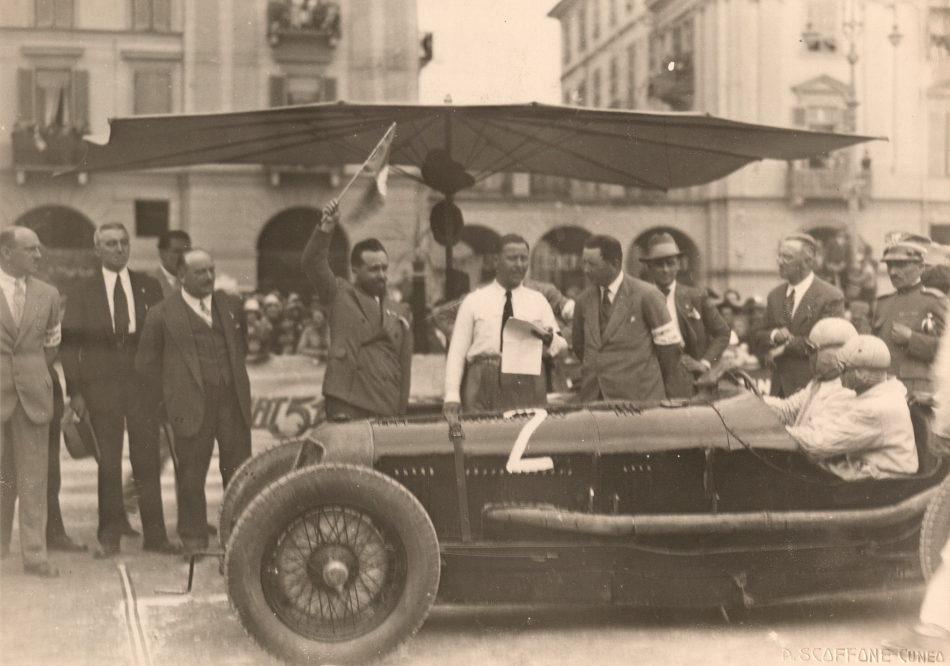
1. Luigi Fagioli at Cuneo, 1930.
The Magistrate of Cuneo signals the start of the Cuneo-Colle della Maddalena Hill Climb for pilot Luigi Fagioli on 29 June 1930. Driving a 3000cc Maserati, Fagioli finished second overall.
A central figure in the evolution of international motor sport, Italy’s Luigi Fagioli (1898-1952) competed at the highest levels of Grand Prix racing from 1928 through to the early 1950s. A versatile pilot, he achieved significant success with both Mercedes-Benz, finishing as runner-up in the 1935 European Drivers' Championship, and Alfa Romeo. Fagioli holds two unique historical records: he is the only Formula One Grand Prix winner born in the 19th century and the only driver to have won championship rounds in both the AIACR (former name of the FIA) and Formula One eras. With his 1951 French Grand Prix win at age 53, he remains the oldest victor in the history of the sport.

2. Rudolf Caracciola, 1929.
Driving the Mercedes-Benz SSK (7.1-liter inline-six), a car engineered specifically for mountain racing, Caracciola dominated the "Sport" category of the European Mountain Championship near Prague. Following back-to-back victories at Zbraslav-Jiloviste and Cuneo, he led the standings with a perfect 10-point score.
A titan of the original "Silver Arrows" period, Germany’s Rudolf Caracciola (1901-1959) was an iconic driver for the Mercedes-Benz racing programme. He experienced extraordinary success throughout his career, including three European Drivers' Championships and three European Hillclimbing Championships. Beyond his circuit racing prowess, Caracciola was a specialist in speed record attempts and mountain trials, famously winning the "Sport" category of the 1930 European Mountain Championship. Known as the “Regenmeister” for his tactical brilliance on rain-soaked tracks, he was the primary architect of the AIACR's competitive standards during the 1930s.
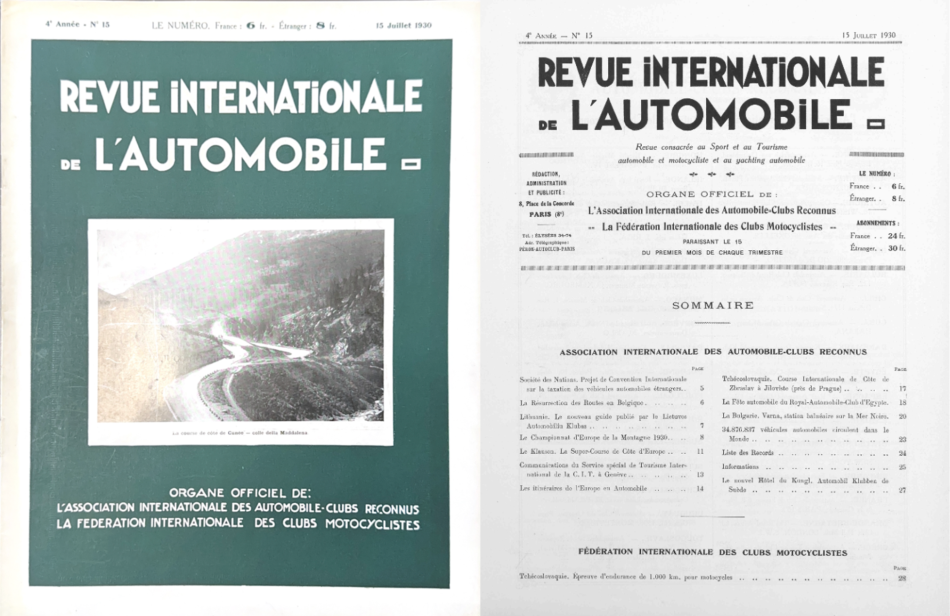
3. Revue Internationale de l'Automobile.
This century-old AIACR quarterly journal was a leading publication for global motoring. This issue (No. 15) is notable for its comprehensive coverage of the inaugural European Hill Climb Championship.
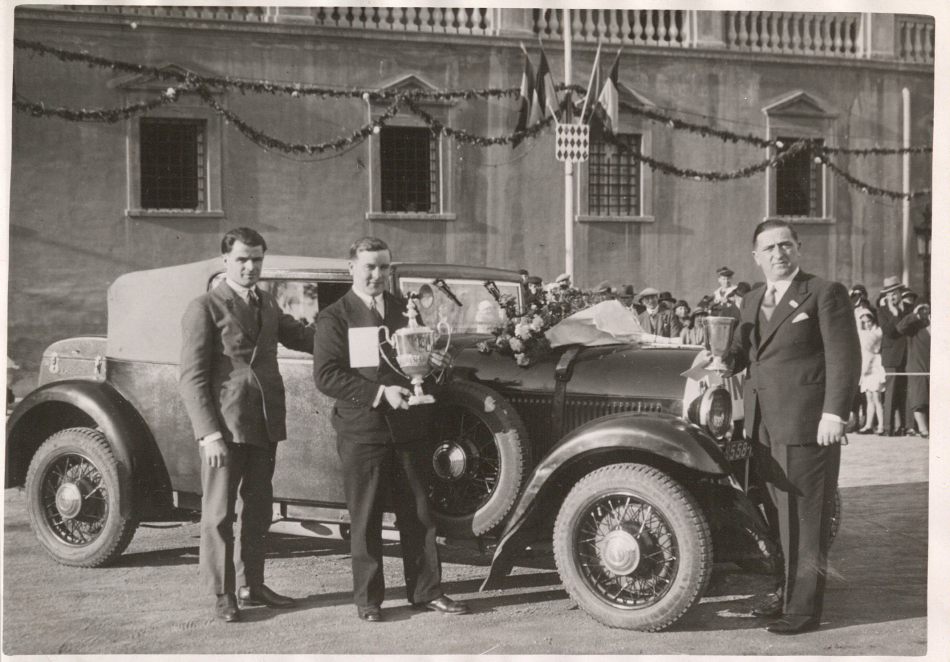
4. XI Rallye Monte-Carlo, 1932.
Entrants Maurice Vasselle and François Duhamel of France took the 2475cc Hotchkiss to victory in the large-car category at the XI Rallye in Monte-Carlo. Photography by "Meurisse," Paris.
Maurice Vasselle (1904-1970) was a distinguished French rally driver, best known for securing two consecutive overall victories in the Monte-Carlo Rally. In addition to his rally success, he competed in the 1951 24 Hours of Le Mans, partnering with Jacques Poch in the diminutive No. 49 Aero Minor. Their entry was of technical interest for its design, featuring a 0.7-liter two-stroke engine made in Czechoslovakia.
Francois Duhamel was a prominent French co-driver and navigator who played an instrumental role in the dominant rally performances of the Hotchkiss factory team during the early 1930s. His greatest successes came through his partnership with Maurice Vasselle, with whom he secured consecutive victories at the Monte Carlo Rally in 1932 and 1933, navigating their 2475cc Hotchkiss AM 80S to the pinnacle of international endurance racing.
The Monte Carlo Rally (officially Rallye Automobile Monte-Carlo) is a landmark event organized annually by the Automobile Club de Monaco. Established in 1911 by Prince Albert I, the rally was intended to demonstrate automotive innovation and promote Monaco as a premier Mediterranean destination. Historically a "concentration rally," competitors set off from various European cities to converge in Monaco, a format that remained until 1997.
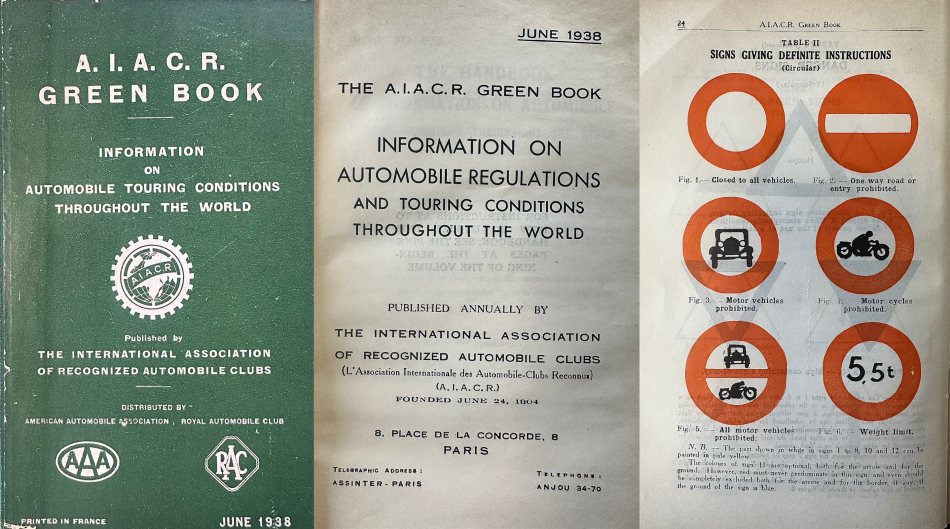
5. AIACR Green Book, 1938.
An essential example of the organization’s mobility mission, this guide provided comprehensive travel data for 41 countries across three continents, supporting the growth of international tourism. This 1,021-page handbook contains vital facts on international conventions, regional regulations, customs, and currency, representing the backbone of early 20th-century automobile touring.
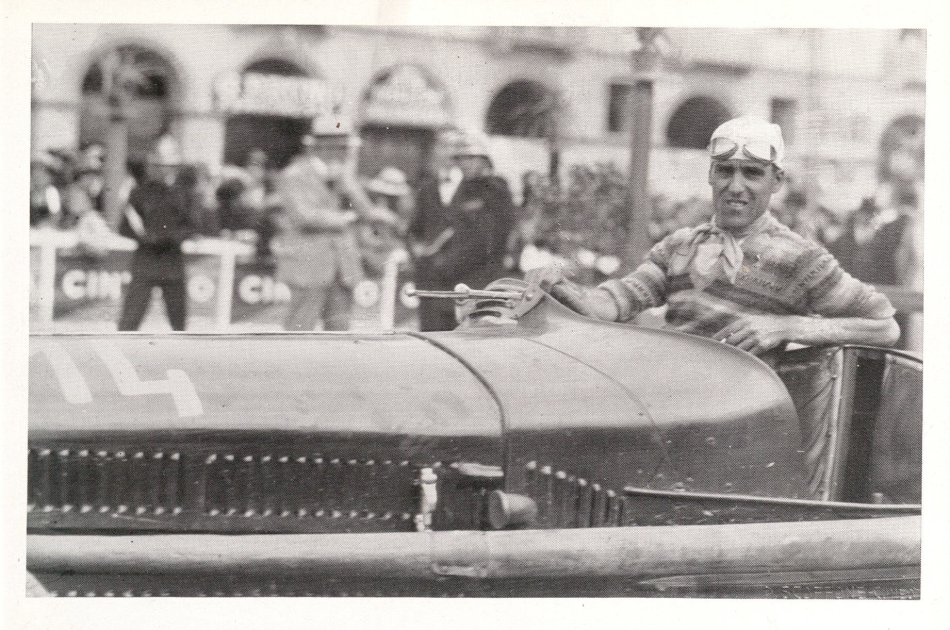
6. Tazio Nuvolari, the "Flying Mantuan".
The legendary Alfa Romeo pilot and arguably the most iconic driver of the 1930s. Following his historic 1930 Mille Miglia victory, Nuvolari reached the pinnacle of the sport as the 1932 AIACR European Champion.
The 1930 European Hill Climb Championship was the inaugural season of the series organised by the AIACR. The championship was secured by two legendary German drivers: Hans Stuck in the Racing Car (RC) category and Rudolf Caracciola in the Sports Car (SC) category.