FIA Formula 2 Championship: 2027 Car Launch - Press Conference Transcript

REPRESENTATIVES:
Bruno MICHEL (FIA Formula 2 Championship), Nikolas TOMBAZIS (FIA)
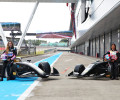
Q: Welcome to our FIA Formula 2 2027 car reveal press conference, following the launch a moment ago, which was attended by reigning World Champion Lando Norris and Oscar Piastri. We’re joined by the FIA F2 CEO Bruno Michel and Nicolas Tombazis, the FIA’s Single-Seater Director. A very warm welcome to you both. Bruno, if we could start with you, please tell us about the goals behind this new car?
Bruno MICHEL: Well, the mission of Formula 2 has always been to prepare drivers for Formula 1 and to make sure that when they get into Formula 1, they are ready. So, of course, the car plays a very important role in this preparation. And what we’re always trying to do, because we are making a new car generally every three years, a completely new car or an upgrade of the existing car, we’re trying to get as close as possible to what Formula 1 is at this very stage, to make sure that the drivers are going to be ready when they jump into Formula 1. And that goes not only with the car, but also with the tyres, because we’re using the same supplier, the same partner as Formula 1, with many other subjects of the car. But we are trying to make sure that the drivers are getting as ready as possible.
Q: OK, thank you. Nikolas let’s come to you. Technically, how different is the 2027 car?
Nikolas TOMBAZIS: This car is actually a significant upgrade over the previous car. So, without answering your question directly, there are a lot of similarities to the previous one, a lot of commonalities for cost reasons and to maintain the financial sustainability of the sport, which is always a priority. With that said, there are some very significant changes on the aerodynamics. As Bruno said, there has been a desire to align much more with the Formula 1 philosophy, so all aerodynamics are new, and I think that will guarantee an even better ability to follow closely other cars, not that this is a problem in Formula 2 in general. And I would say there’s also the starter motor, which has been added. That is, again, another important feature in order to avoid, from a sporting point of view, having stalled cars around the track and interrupting the flow of races because of that. The car does have more downforce. I think it’s about 25 points of downforce and a bit more drag, three points. So, it’s fundamentally a much more efficient car dynamically, as well as having better characteristics for following other cars and being more similar to Formula 1, and hence a better proving ground for drivers learning, going up the ladder to get into Formula 1.
Q: How complicated has it been to introduce the starter motor specifically?
NT: It’s obviously an important project. I don’t think it’s an engineering miracle. It’s just there’s been the desire to spend some time and some weight, but the extra weight of that is more than compensated with the better aerodynamics.
Q: Thank you. Bruno, if we come back to you, the car has already tested in Hungary back in June. What feedback did you get from the driver, Paul Aron?
BM: Well, we had very positive feedback because the good thing with Paul is that he’s been driving the former car as well, so he could have a very interesting comparison between the two cars. And he said that it was very pleasant to drive. He said that you could tell definitely that there was more downforce in this car, that, as Nicolas said, the little additional weight that you got because of the onboard starter, you couldn’t feel it at all, and that he thought that the races were going to be very interesting. Now, as long as we don’t have 22 cars on the track together, we don’t know. But we’re quite confident, with all the work that’s been done aerodynamically between the FIA and ourselves, that we will have a very beautiful car to race.
Q: And what are the plans for the rollout of the new car? When will the teams start to receive the car?
BM: We’re continuing testing the car. We’ll take the car in the wind tunnel because what we want also is to centralise all the information from the 100% wind tunnel to pass the information to the teams, so they will get all the data so that they don’t have to do it themselves. And then the idea is that the first car will be delivered at the end of the year to the teams, and the second car sometime at the end of January. And then we’ll go testing with 22 cars, because it’s always different when you have a test with one car and when you have a test with 22 cars. And then the cars will be ready to fly to the first race for next season.
QUESTIONS FROM THE FLOOR
Q: (Jon Noble – The Race) To Nikolas, you’ve talked about adopting some F1 philosophies. What are the key fundamentals from Formula 1 that have been transposed onto your understanding of aero? And are there also elements of the platform that can flow the other way, so understanding some F2 can influence rules in the future?
NT: I would say it’s mainly a flow from Formula 1 to Formula 2. Formula 2 does have an advantage compared to Formula 1 that teams do not develop the cars and therefore cannot find any, let’s say, loopholes or any aero devices that perhaps could compromise the philosophy, even though in Formula 1 we have been very careful to try to minimise that as much as possible, and I think the feedback is quite good. Fundamentally, the principal changes relate to how the front-wheel wake is being dealt with. That small board in front of the sidepod helps keep the front-wheel wake quite close to the inside of the car and to go over the floor, between the coke panel and the rear wheel. And ensuring that means that the wake going to the rear car is much cleaner because the upwash of the rear wing moves all the dirty air a bit further up, and what stays low down for the following car is actually quite clean air coming from outside. So, that is the key philosophy that has been adopted. All of that, of course, works hand in hand with a new front wing endplate, which has to go together with that wheel-wake management. So that, I would say, is the key part. And then, of course, the diffuser is similar. The rear wing doesn’t have a huge effect on the following performance, but it is a bit simpler with that sort of philosophy to adjust the rear wing, and that is also for cost reasons. Actually, that was one of the reasons in Formula 1 too.
Q: (Josh Suttill – The Race) Nikolas, obviously F1 has kind of dropped DRS and moved to active aero. Was that a consideration to kind of change and evolve that on the Formula 2 side, and what was the motivation for keeping it?
NT: Not really. In Formula 1, it was because of the energy characteristics of the electrical motors in relation to the ICE. That is not an issue in Formula 2. In Formula 2, the power is all from the combustion engine, so there was no need to have movable aerodynamics like in Formula 1. Instead, the DRS remains a very valid principle, valid concept to use in Formula 2.
Q: (Carlo Platella – FormulaPassion.it) Question for Mr Tombazis. Are there any improvements on the safety side, for example structures, the safety parameters of this car?
NT: Well, this car, let’s say the cousin or the big brother, let’s say, was introduced in 2024 according to the safety parameters of Formula 1 at that time. Formula 1 has moved on a bit for ’26, but not by a gigantic amount. The priority here was to keep the same chassis for cost reasons, for the financial sustainability of the sport, and that is a very important feature and concept for the FIA and for Bruno – to keep the costs as contained as possible. So, the decision was taken to keep the same chassis. Hence, there are no major safety improvements. The next safety improvements in Formula 2 will be in 2030. I think I would like to see the glass half full rather than half empty, because I think the safety standards are already extremely good in Formula 2. But there will be probably an upgrade in the next generation.
Q: (Alejandro Alonso Lopez – DiarioMotor.com) Question to Nicolas. Obviously, there is a significant upgrade to the front wing and the rear wing. Have there also been upgrades to other parts that are not so visible, like the floor? How much has the diffuser changed?
NT: No, the whole car has changed aerodynamically. In modern single-seater aerodynamics, all of these components interact with each other. You can’t just change the front wing and leave everything else unchanged. So, the floor has changed, as well as the whole car, basically. But please also, you know, you need to remember my friend Bruno here.
Q: (Valentina Peña – DiarioAS) This question is kind of for both of you, but usually when there are changes of regulations, there is the opportunity to have different teams coming up to lead the table. Recently, we have seen Campos and Invicta probably as the strongest teams in Formula 2. How confident are you that these changes in their dynamics allow to have maybe different teams coming closer to them?
BM: Well, it’s something that is quite interesting because it’s true that, over the last years, the teams that were doing well with the last car maybe were struggling a bit, and there are new teams coming up and having better results. It’s very difficult to say. What is true is that when we introduce a new car, we know that there’s going to be a reshuffle, definitely, in the order of the teams. Of course, the drivers as well make a massive difference, so it’s not only the teams. And maybe when you see what Campos and Invicta have been doing, they’ve been having very strong drivers over the last two or three years as well, so that makes a difference. But yes, the idea when we introduce a new car is always to make the engineers work a little bit more and not, you know, sit on what they’ve been doing for the last two or three years. So, it will be interesting and we’re going to see that, I’m sure.
Q: Nikolas, your thoughts? Are you expecting a reshuffling of the pack?
NT: Yes, I agree completely with what Bruno said. I would expect a bit of a reshuffle. Of course, in Formula 2 the margins are a lot smaller, the margin for variations, and understanding the car platform is what gives the edge to some teams compared to others. So, whereas there’s common data, like Bruno said, for example the wind tunnel data goes to all the teams, now who interprets that data in the best way, who optimises the car set-up, is very important for performance. And additionally, of course, to have a competitive race, you need to get a lot of things right – operationally, tyre temperatures, a lot of other things – and who understands all of these fine details better will actually have the better package.
Q: (Jon Noble – The Race) To Nikolas, the DRS rear wing design of the current car was quite unique when it first came out. The design is different now for this version and doesn’t actually appear to run across the whole rear flap section. What’s the thinking behind the concept and why is it a step different to what we’ve seen before?
NT: The main reason for the adoption of the new system was to basically align with the F1 overall car looks, I would say. The DRS authority, i.e. how much extra drag reduction you get and what delta speed you get, has improved slightly with this new design.
Q: (Frederik Hackbarth – F1-Insider.com) The question also to Mr Tombazis. Within the last couple of years, we’ve seen some outliers regarding the drivers that progressed to F1 not being front-runners, like if you think of Kimi or Ollie Bearman in F2, which then led to comments that it’s so different, driving style-wise, F2 and F1, that being a good F2 driver doesn’t necessarily mean you’re a good F1 driver and vice versa. How did you approach closing that gap, also keeping in mind the electrical power percentage now in F1 that you don’t have in F2?
NT: I don’t very much agree with this assessment. I mean, you’re right about the examples of these drivers, but we also have a lot of other examples of champions in Formula 2 winning in Formula 1 as well. I think the cases you mentioned, for example, Kimi was still very new in Formula 2 and was still learning. He had started winning and then the season was over, and then he moved to Formula 1, and he spent a year learning there before he started winning quite a lot. So, I would certainly not like to support a notion that the driving is that different. Now, of course, the cars are different. There’s a lot of additional things people need to learn in Formula 1 in order to manage the cars, and there’s a lot more detail, and clearly some people make that step better. But my basic message is that Formula 2 remains a fundamental and extremely valid last step before you get into Formula 1. That would be my view.
Q: (Josh Suttill – The Race) Bruno, can you tell us about the timeframe for the new team selection in terms of Lando Norris’ team, and how much of a credit is it to the championship to have that interest?
BM: Well, we do a new selection every three years, so that’s where we are when we have a new car as well. We’re in the process of this selection at the moment, so we will come up with a list of teams within one month, I would say, one month and a half. So, it’s going to be quite soon. And of course, Lando Norris’ team has been applying for a licence, and we’re looking at it like we’re looking at any other request. There are a lot of teams that would like to join Formula 2 at the moment. It’s a very healthy championship, but we’re not going to increase the number of teams because that’s something that is quite important for the health of the teams. And also, you know, I think 22 drivers in F2 is good enough when you have 22 drivers in F1, and that you know that some years you will have seats in F1, some other years it will be more difficult. So, we need to be also quite careful about it. So, we’ll keep the same number of teams, and the results of this selection will come quite soon.
Q: (Cliona Sheerin – FeederSeries.net) A question for Nikolas. How much collaboration with the F2 teams themselves went into this design?
NT: The main collaboration is with Bruno’s team in FML and with Dallara, I would say. Clearly, the Formula 2 teams give us feedback and we take that on board, but the main collaboration is with the actual team working to make this car and, of course, with the promoter.
ENDS
 Facebook
 Twitter